
Cities & Holdings
Tap one of your cities and the city board opens straight away — with or without a party selected on it. Cities level from 1 to 3 — each level adds job slots, a floor to the skyline, and eventually unlocks the best projects.
Jobs
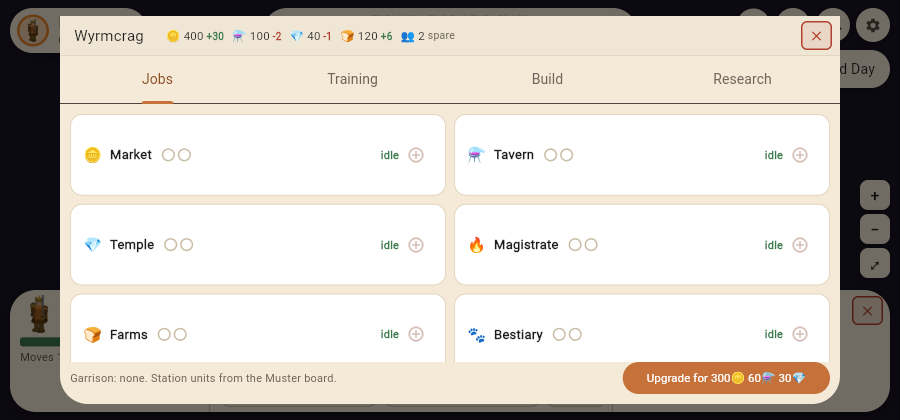
Spare Followers work the city's crafts: the Market (gold), Tavern (elixir), Temple (reagents), the Farms (food), the Magistrate (infamy) and — once you have raised one — the Bestiary (beast lore).
Every craft pays the same daily worth; only the coin differs. One keeper earns 25 gold, or 16 elixir, or 12 reagents, or 25 food — the same value at the rates guilds trade them. So posting a keeper is a choice of what your city makes, never of how much. The Magistrate is the exception: infamy is not traded, and it earns at its own slow pace. Infamy still matters — your deeds plus your magistrates decide how many new Followers arrive every seventh day.
A posting is permanent
A Follower settles into their craft and does not come back out. Spend them like skill points: the number posted to a craft is that craft's level, and some things — beast lore especially — will not open until a craft has been raised high enough.
Walls and garrisons
Any holding takes at most 10 soldiers — enough to hold a gate, not enough to make a fortress unassailable.
Defenders fight a little steadier for standing behind stone: a city or Grand Athanor is worth something on its own, and a city's walls add their course on top. They also sharpen the drill of everyone posted behind them — in peacetime and during a defence.
Walls belong to the city, not to a tile. Every city is founded as a walled town, and raising the walls builds the city itself up rather than putting a separate structure on the ground beside it: open the Build bench and pick City Walls. Each course is paid for at once, shows on the city's miniature — taller towers, and pennants at the third course — and cannot outgrow the Town Hall, so raise the hall to raise the walls further.
Food & farms
The faithful march on bread, not coin: every recruit costs 1 Follower, 40 food and 20 elixir — gold buys mercenaries, structures and training, never the faithful. Cities grow a base crop (villages a smaller one), Farm workers grow more, and for real granaries you settle farmsteads: hire a Farm Hand from the Recruit bench at any of your cities (100🪙), march them out with a party, and on held, empty ground Settle a farmstead appears in the party's Skills sheet.
A hand carries seed for two fields. The first sowing leaves them with one charge, and the second uses them up — they stay behind to work that last field. If you have no hand to spare, a Charter of the Furrow in the satchel does the same job once, and any hero can present it.
A farm hand never fights. They are on the party's roll, they travel with the column and they eat, but they are not marched into a battle line — and a holding garrisoned only by hands counts as undefended, so do not mistake one for a guard.
Each farmstead yields 10 food a day at full control, and like any holding of yours its fences ward the blight. A ring of farms is both a food supply and a wall.
Hiring
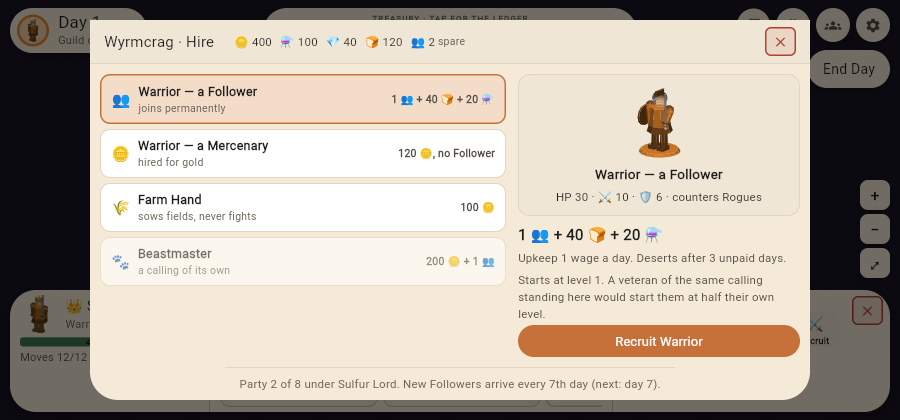
Recruit is the one door onto everything a holding will take on, and it works like the Build and Research benches: the list names what is on offer here, and tapping a row explains what it costs to keep before you spend a coin on it.
| Hire | Where | Costs |
|---|---|---|
| Follower | any hall that trains that calling | 1👥 + 40🍞 + 20⚗️ |
| Mercenary | the same | 120🪙, no Follower |
| Farm Hand | any city | 100🪙 |
| Beastmaster | a level-3 city | 200🪙 + 1👥 |
| A beast | its own captured lair | a fortune, and daily gold |
A veteran of the same calling standing at the hall is a mentor: a new recruit starts at half their level. Mercenaries never get it.
Training
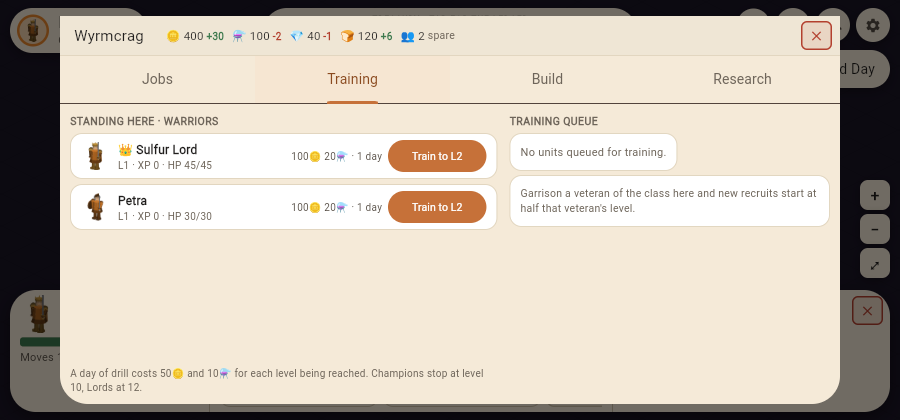
Every unit standing at the building — in a party or the garrison — can buy its next level for gold and elixir. The drillmaster only charges for what is left to learn: a soldier already three-quarters of the way to the next level pays a quarter of the list price, so battle scars are money in the bank. Training takes the day; the queue shows who's drilling. Keep a high-level veteran garrisoned and new recruits start at half their level.
Barracks train warriors, Laboratories train alchemists, Shadow Guilds train rogues; cities and Grand Athanors drill warriors. Tap any owned trainer building on the map to open its hall directly.
Build
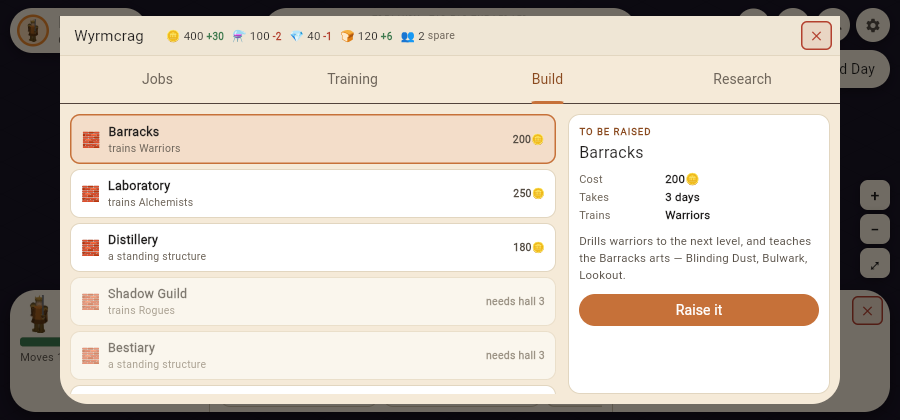
Cities can raise new structures on free land beside them — a Barracks, Laboratory or Distillery, and at city level 3 a Shadow Guild. One project at a time; a few days each — and one of each per city. Once a structure stands, its row becomes the upgrade path instead: a structure can rise up to its city's level (raise the city first to raise its halls higher). Each level multiplies the structure's daily yield, and each level above the first cuts training costs at that hall by 15%. Tap the structure on the map to see exactly what an upgrade buys and costs.
The same bench also carries City Walls, which are not a structure at all — they are the city's own curtain, so raising them takes no land and no days. See Walls and garrisons.
Research
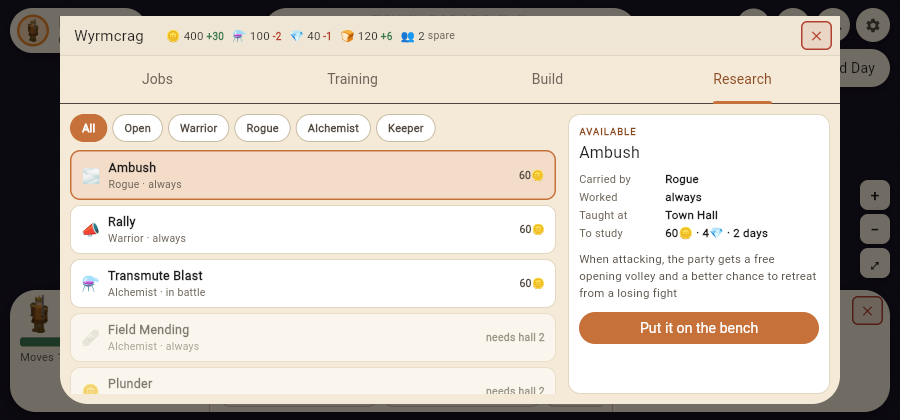
The Town Hall researches hero skills, one project at a time, guild-wide once learned. Nothing is granted: even a Lord's own class art (Rally, Ambush, Transmute Blast) is a study — the cheapest on the bench, and the one to start with. A level‑2 city unlocks the deeper studies (Shield Wall, Plunder, Field Mending) and a level‑3 city the masterworks (Warcry, Overwhelm, Quicksilver March). Once researched, assign the skill on any matching hero's sheet.
The Town Hall is not the only school. A Barracks, Laboratory, Shadow Guild or Bestiary teaches arts of its own trade that the hall never offers — which is a reason to raise them past drilling in them. The full tree lives in Skills & Research.
Defense
If a visible enemy prowls within sight of an undefended holding, the game warns you and offers an emergency muster — recruits or mercenaries straight onto the walls. The warning has a Take me there button that flies the map to the threatened holding, so you can see what is coming before you decide whether to defend it.
The Troops button on the HUD (the shield) is the muster roll for your whole realm: every holding with its walls, its garrison and how firmly you hold its lands, followed by your armies in the field — each row with its own Take me there. An undefended gate is flagged in red at the top of the list, so you spot it before an enemy does.
Garrison duty pays on its own, too: a soldier standing a wall earns a slow trickle of experience every day — the wall is a drill yard. Heroes learn from deeds, not drills, but a green recruit posted to a quiet hold comes back sharper. Between the drills and their wages, a standing garrison keeps your surplus working instead of piling up.