Heroes & Parties
The command bar
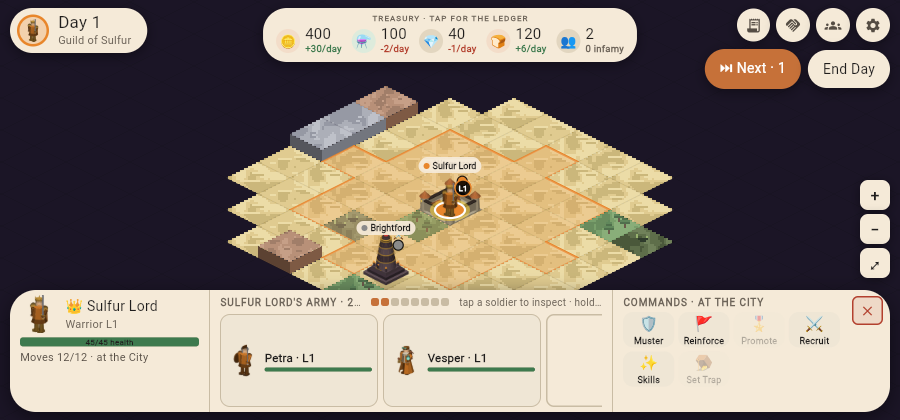
Selecting a party raises the command bar across the bottom of the screen. Left to right:
- The portrait plate carries your hero's vitals, movement, station, and travel status (with a Halt for standing orders). The ✕ deselects; tapping the hero opens their unit sheet. When several of your parties stand on one tile, ◂ 1/2 ▸ on the plate pages between them.
- The soldier tray is always open, named for the party it shows and scrolling sideways: a card for every soldier with their figure, a health sliver and one badge for whatever matters most right now — unpaid (red), 💰 mercenary, ⚒ drilling, ✋ wage withheld, or 🎖 ready for promotion. Marchers on the road hold their slot with a green 🚩 and their arrival day. Tap a soldier to inspect them; hold to open the Muster board.
- The command card keeps its six slots in fixed places and greys them out of context: 🛡 Muster, 🚩 Reinforce, 🎖 Promote (lit and counted when someone qualifies), ⚔ Recruit — the one door onto every kind of hire this holding offers — ✨ Skills, which gathers the hero's arts and the party's errands, and 🪤 Set Trap, which is field work and lights only in the open.
The unit sheet
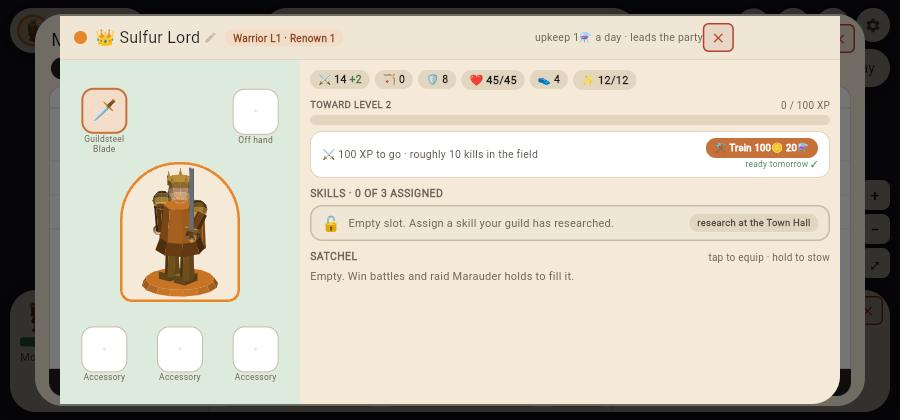
Tap any soldier — hero or regular — and their unit sheet opens: one screen for everything about them. The figure on the left is that soldier in three dimensions, wearing your banner's colours — a Lord in crowned plate, a bow-armed rogue as an archer, a champion in circlet and plume, a chimera in its own hide. Tap the name at the top of the sheet to rename that soldier. The paper doll around it shows their two hand slots and three accessory slots; weapons, shields and artifacts come from battle spoils, marauder hoards, and dungeon chests, and ride in the satchel of the party that found them. Tap a satchel piece to equip it, tap a worn piece to stow it. The guild vault is another matter: it opens only inside one of your cities, so what one party finds in the far wilds reaches another party's hands by walking it home or sending a scout. Inside a city, Store all in vault on the sheet stows the party's finds (or hold a single item's chip to stow just that one); carried pieces are marked 🎒 and vaulted ones 🏛. A few tricks of the trade:
- Warriors are strong enough to wield a two-handed weapon in each hand.
- Rogues shoot bows half again as hard, and a matched pair of daggers turns them into a whirlwind.
Heroes also carry up to three skills, and every one of them is studied before it is carried — the class art included. Research happens at a city's Town Hall (or, for the trade arts, at a Barracks, Laboratory, Shadow Guild or Bestiary), and a mastered skill can then be assigned to any hero of the right class. The full catalog of arms lives in Arms & Artifacts, and every skill and its research path in Skills & Research.
Paying the army
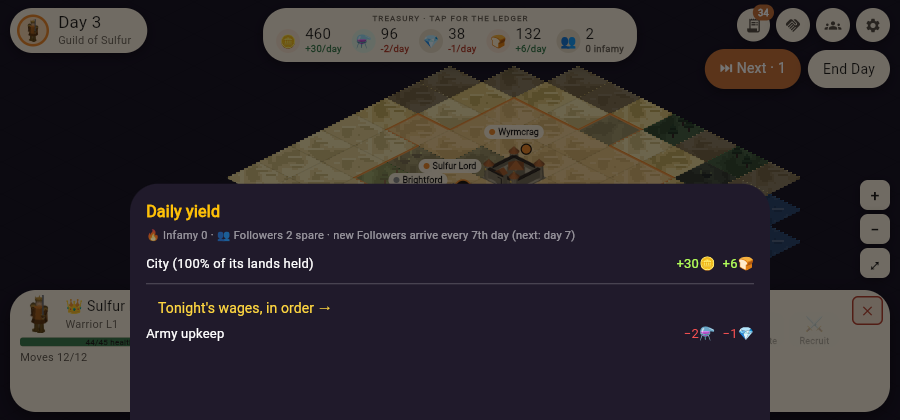
Every soldier under your banner draws a wage at dusk — heroes and garrisons included: 1⚗️ a warrior, 1🪙 a rogue, 1💎 an alchemist, 4🪙 a mercenary, and a creature's own keep. The purse pays out in a fixed order: heroes first (your Lord is always first in line), then anyone you have ⭐ pinned, then the field armies, then the walls. When coin runs short the tail of the line goes hungry — and every soldier keeps their own count. Three unpaid days and a regular deserts. A mercenary walks the first night pay is missed. An unpaid creature rampages through its own ranks and flies off. Your Lord grumbles, but stays.
Three places tell you where you stand. The treasury strip across the top of the map carries every coin with its daily net beside it — tap it for the day's ledger, which holding pays what and what the army costs. The Muster Rolls carry the pay line itself, footed with tonight's reckoning and flagged ⚠ At risk when anyone will go short. And if someone would go unpaid, the dusk reckoning opens by itself when you end the day: the bill grouped by cause, how long each resource lasts ("dry in 2 days"), and who walks first — each with a one-tap out. And if ending the day would leave anyone unpaid, the reckoning opens by itself, so desertion is a choice you saw coming, never a surprise.
Two levers on the Muster Rolls put a shortfall under your control: ⭐ pay first pins a soldier to the front of the line, and ✋ withhold deliberately skips their wage — a wager against their three days of grace, for when the coffers need room to breathe. Heroes and mercenaries refuse to wait.
When a soldier has outlived their wage, disband them: half the bread and elixir that raised them returns to the stores (+20🍞 +10⚗️), though the Follower is spent. Mercenaries and other gold hires are dismissed with nothing — their pay stays spent.
The Muster Rolls
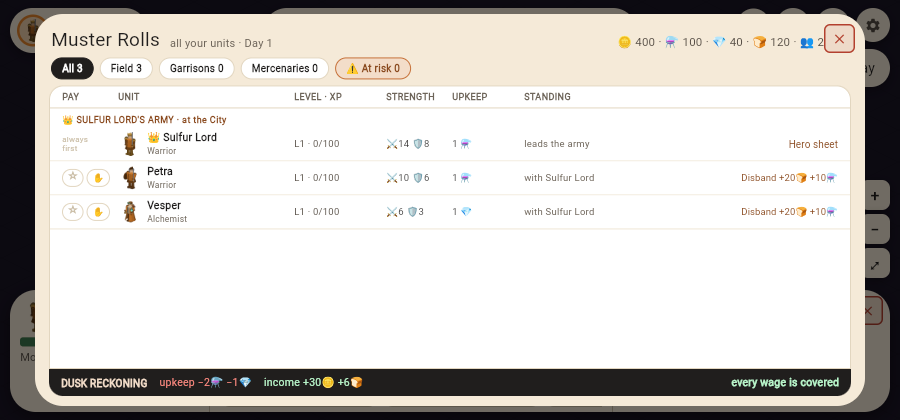
The 👥 button in the top bar opens the Muster Rolls: every soul under your banner — field armies, garrisons, marchers on the road (recallable from their row), even scouts away on errands — with level, strength, wage and standing side by side. Filters pick out the field, the walls, the mercenaries, or everyone at risk; copper rows are ready for promotion, red rows are in pay trouble; the ⭐/✋ toggles live on every row. The dark footer answers "can I afford my army?" at a glance and names the resource that runs dry first. Tap any row to open that soldier's unit sheet.
Growing your forces
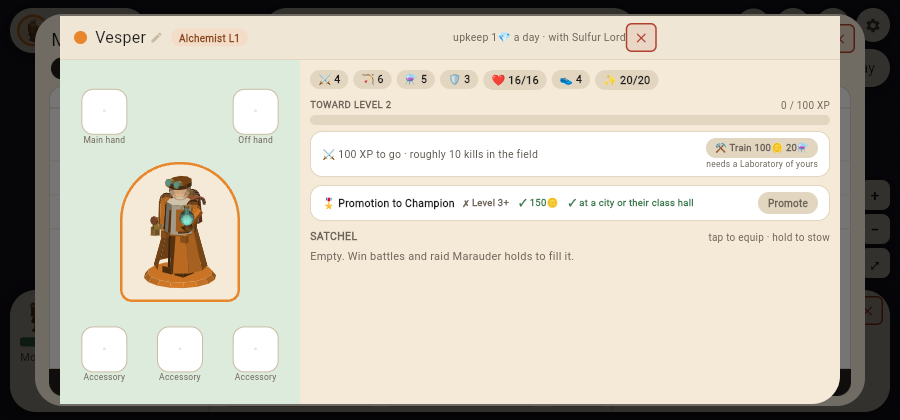
Units level up from battle (experience for wounds dealt and kills) or paid training. The unit sheet lays the two roads on one line: earn the XP in the field (free, but they can die trying), or pay the drillmaster — who only charges for what is left to learn. A soldier three-quarters of the way to the next level trains for a quarter of the list price, so field experience and paid drilling work together. Training needs the soldier standing at one of your halls of their class, and the new level lands at day's end.
Recruiting takes a Follower plus food and elixir (the faithful march on bread, not coin), and every recruit signs on under a name of their own; mercenaries cost pure gold but demand pay every day and walk the moment you miss it. A veteran of the same class standing at the recruiting building mentors newcomers — recruits start at half the mentor's level.
Champions and more heroes
A veteran of level 3+, standing in one of your cities or at the hall that trains their class (a rogue at a Shadow Guild, a warrior at a Barracks, an alchemist at a Laboratory), can be promoted to Champion for 150🪙 — a hero who can lead a party of their own (every hero leads up to 8 units — 10 under The Long Column). The unit sheet shows the whole road as three checks — the level, the coin, the ground — with the button right there when all three pass; the command card's 🎖 slot lights up whenever anyone under the selected hero qualifies. A fresh champion raises a banner of their own on the spot — they split into their own party the moment they are promoted (marching from the next day); draw soldiers to them from the Muster board. Rarely, a dungeon holds a caged hero who will join their rescuer — champion-ranked, but expensive to keep.
The Muster board and reinforcements
At any of your buildings, the 🛡 Muster slot opens the board: every party on the tile and the garrison stand side by side as columns. Drag a soldier between columns — or onto the walls to station them — or tap a soldier for their orders. Every chip carries its daily wage, and the eligible carry their promotion button inline. Stationed units defend the walls (and mentor recruits at trainer buildings) until a hero fetches them back.
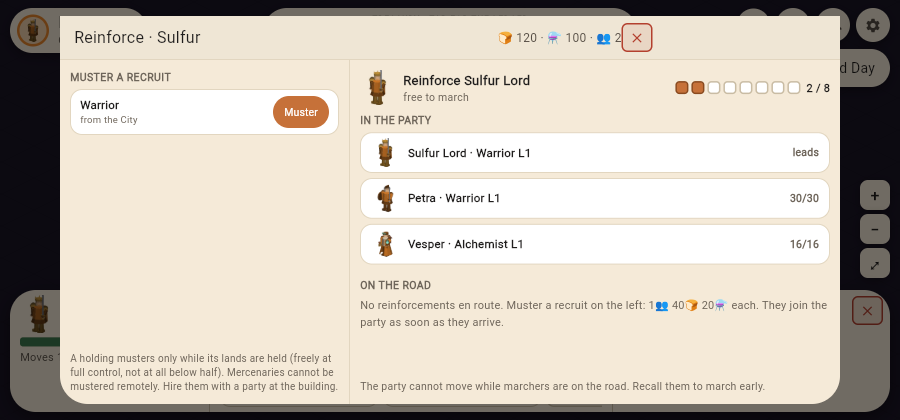
Reinforce musters a recruit by class — the board lists what you can raise, notes the holdings it draws from, and picks your best source (strongest mentor first, then nearest) — and the recruit marches cross-country to the hero. The receiving party holds position until every marcher arrives. The 8-slot cap counts marchers on the road, contested holdings (under half their land held) cannot muster at all, and you can recall a marcher home to move early.
Scouting and couriers
Scouting is a rogue's trade, not a unit you buy. Any rogue marching with a party — anyone but the hero leading it — can be sent out from the command card's 🔭 slot; the fastest one rides. Choose their errand:
- Chart the unknown: they ride for unexplored country, burning off the fog of war in a wide circle as they go, then turn for home.
- Carry the finds home: they load up everything in the party's satchel and deliver it to the vault of your nearest city.
Either way the party keeps marching; it never waits on a rider. The return leg chases wherever the party has gone since, so a three-day errand becomes a longer one if you have marched two days the other way. Send a rogue and the party loses a blade until they return — and a rogue who takes up a bow rides as an archer on their unit sheet.