
Battles & Dungeons
Joining battle
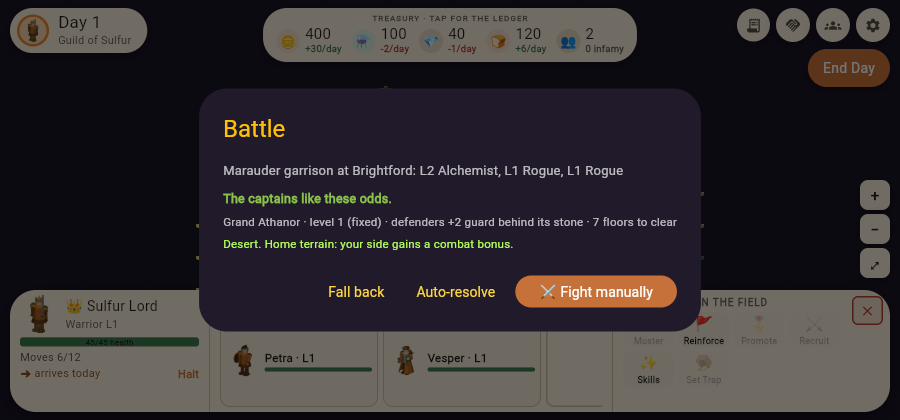
March onto an enemy and the game pauses to ask how you want to fight: Auto-resolve for a quick outcome decided by the dice, or ⚔ Fight manually to take the field yourself. You can also Fall back, unless you have been ambushed.
If you would rather fight every battle by hand, the menu's Battle setting hides the shortcut altogether — see Settings & Unlocks.
Before you choose, your captains size up the fight and say so plainly, from "expect a rout" down to "counsel against this fight". When the counsel runs red, believe them.
Every engagement begins one of three ways. Ambushes either way are rare (a few percent, swayed by level difference — and rogue lords with the Ambush skill spring them more often):
- Sprung ambush — you catch them unaware. On the field they stand asleep and take no turns until first struck.
- Battle — the sides face off and act in turns.
- Ambushed! — the enemy surrounds your party mid-field, and there is no declining the fight.
Defending your holdings
When a rival storms one of your buildings and a garrison is standing in it, the fight comes to you the same way one you started would: the same appraisal, the same choice to settle it quickly or take the field yourself. You cannot fall back — it is your own gate — and if the garrison is cut down the walls change hands there and then.
Leave a building empty and there is nothing to defend with: it simply falls. Station soldiers from the Muster board on anything you mean to keep.
The tactical field
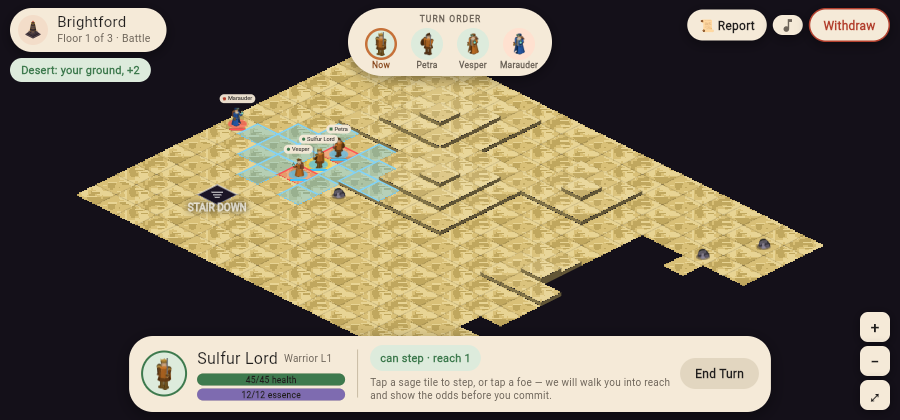
Turns run by unit speed; each unit gets one move and one action. A turn you do not spend is not wasted: hold your ground and your blow, and that unit comes round faster next time — enough that a slow soldier who waits can act before a quick one who ran and swung. Blue tiles show where you can step. Tap one to preview the move (and the red reach it would give you), then confirm. Red tiles show your weapon's reach: adjacent for melee, three tiles for shooters. Heroes with Transmute Blast get a cast mode that burns half their Essence on one target. Rally, Shield Wall and Overwhelm all apply on the field, and Withdraw breaks off the fight.
Home ground counts. A soldier fighting on their own guild's home terrain strikes and guards 2 better; on their sworn rival's terrain, 2 worse. The pre-battle counsel tells you whose country you are standing in, and the battlefield's panel repeats it. Since a rival's ground also costs double to march across, invading a rival is hard in both senses.
The field itself is the country you fight in: forests and marshes give thick cover, sand and ice give almost none, and highlands and broken country climb in hills and crags where a marsh lies flat. And no two fields are alike — every battle rolls its own size and shape, with ragged voids bitten out of the edges where the ground simply ends. Nothing walks or stands on a void, so mind the map's edge when you plan a flanking run.
Pinch to zoom into the melee and drag to pan while zoomed, or use the + / − / ⤢ pad in the corner.
Reading the odds before you commit
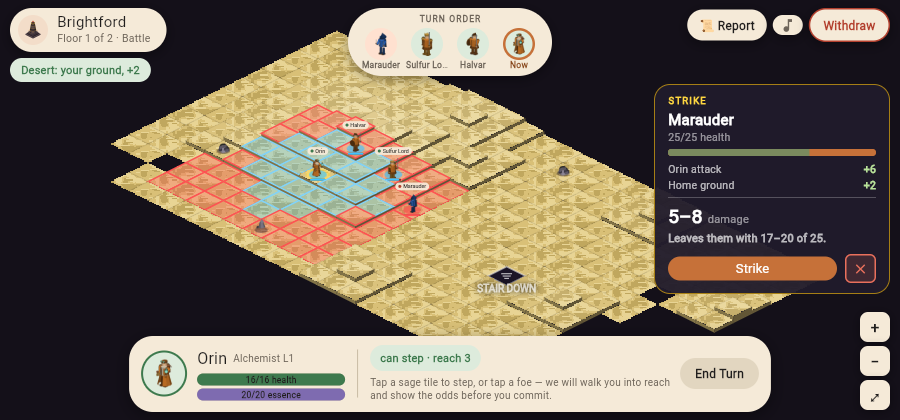
Tap a foe in reach and the strike card lays the whole sum out: every term that went into the blow — your attack, the ground, the rally, half their guard, the flank you are hitting from, the height you hold — the damage it would do at best and worst, and whether that finishes them.
Nothing is rolled until you press Strike. Tap the same foe again, or press the button; ✕ calls it off. If you are stepping into reach first, the card costs the blow from the tile you are about to stand on, not the one you are on, and offers the step and the strike as one decision.
Where you stand, and which way you face
Fighters look the way they last walked, and turn to face whatever they strike — and where a blow comes from is decided before they turn. Hit a foe in the flank and it lands for a quarter more; get behind them and it lands for half again. Circling costs a turn; it is usually worth it.
You can see all of this. The lines form looking at each other, and every soldier on the field is drawn turned the way they are actually facing — so a back to work round to is a back you can pick out before you spend the turn walking there. Columns on the world map turn the same way, and face the road they are marching.
The ground counts too: every full height you hold above a target adds 10% to the blow (up to 30%), and fighting uphill costs you a little.
Thickets are cover. Anyone standing in scrub is harder to hit — thick in forest and swamp, almost none out on sand or ice. It is the field's answer to the high ground: somewhere worth walking to that costs nothing to hold.
A charge counts. Cross two tiles or more and strike, and the blow lands harder for the running start. Shooters get nothing from it.
Nerve counts. Every fighter starts steady on three pips. Watching one of their own fall costs the whole side a pip, and a unit worn down to nothing is shaken — their blows go a little wide until the fight turns.
Skills you use, and skills you carry
Some arts simply apply — Rally, Shield Wall, Beast Bond. Others are used on the field, and cost that hero's action:
| Art | Who | What it does |
|---|---|---|
| Transmute Blast | Alchemist | Half your remaining Essence plus your craft, armour-ignoring — castable again while the pool holds |
| Quickening Balm | Alchemist, Beastmaster | Laid on ground; heals whoever stands there a few turns later |
| Vitriol Flask | Alchemist | Eats a three-tile square — your own soldiers included |
| Shadow Step | Rogue | Melts into cover; most blows miss until your next turn |
| Assassinate | Rogue | A knife from behind or above. Never from the front. |
| Ensnare | Beastmaster | A net over one foe: no steps for two turns, though they still fight |
| Blinding Dust | Warrior | Grit in the eyes: half their blows go wide for two turns |
| Quicken | Alchemist | Hurries one ally: they come round in the order much sooner |
Where each is studied — and the passive arts that come with them — is in Skills & Research.
High ground and hard landings
No field is flat. The ground rises in half-step ramps toward hills and crags, and boulders squat on the low ground where nothing can walk. Use them:
- Shooters reach one tile further for every full height they hold above their target. A bowman on a crag commands the valley.
- Half-step ramps climb free. A full-height jump up costs an extra move point, and nothing on foot climbs more than one full height in a step.
- You can leap down any distance, but a plunge past three heights deals fall damage on the landing (the move preview warns you first). A fall bruises; it never kills outright.
- Winged creatures such as the Chimera ignore all of it: heights, ramps, falls.
- Boulders block the charge. Put one between your archer and a foe's sword and make them walk the long way around.
Dungeon floors
Garrisoned buildings fight floor by floor — the defenders split across the building's floors, and the STAIR DOWN hatch stands somewhere different on every floor. Clear the floor and the stair lights up: descend and fight on. With a rogue hero you have two more options:
- Sneak past the next floor at the door — 25–75% by level. Fail, and that floor falls on you as an ambush. The last floor can't be skipped: a good sneak there slips you in unseen instead — the defenders stand unaware until you strike.
- Slip down mid-fight — walk your rogue onto the stair tile and the whole party can follow them down with the floor unbeaten, eating parting blows based on how close the enemies stand and how fast each runner is. Slow units can die on the stairs. The stair lands somewhere new each floor, so getting your rogue there is the game.
The prize at the bottom
The last floor of every hold shows its vault chest right on the field — closed while defenders stand, and it blocks its tile like a boulder. Clear the floor and the chest springs open where you can see it: the spoils show on screen, and the Take the spoils button walks you out. Inside: coin and stores scaled by how deep you fought, an artifact — finer the closer to the world's blighted heart — or, rarely, a caged hero who joins their rescuer. Victors also strip the fallen of their gear, and beaten marauder garrisons often guarded a hoard.